

During our time in Ghana, the days started out hot. And, then got a bit hotter. And a bit more humid. And, then hotter and more humid. Soon, it seemed as if your sweat was sweating.
Can you imagine a full body quilt made of perspiration? I can’t quite find the right word to describe it…except to simply say it was just too hot.
We spent four days in Ghana. The colors, the music and the food are all embodied with joy. The people are hard-working, upbeat, proud and welcoming. Although it was too hot, Ghana was also just too cool.
On our first day, soon after the ship pulled into the port city of Tema, 31 students and I boarded a bus to explore the world of cocoa. It was a ‘field class’ – the in-country-based, experiential learning component of one of my courses.
Here’s the quick back story to why the field class focused on cocoa in Ghana. Ghana has long been one of the world’s largest producers of cocoa. (You know…that stuff used to make chocolate? You’ve seen the dark chocolate bar that’s ‘70%’, meaning it’s 30% stuff other than cocoa.) Teaching on Semester at Sea provides a very unique opportunity to connect what students know and do back home to the source; for example, connecting the purchase of a chocolate bar at the local convenience store in Portland, Oregon, to the growing and harvesting of cocoa beans outside of Accra, Ghana. And the thing is, there’s a dark side to cocoa. No, I don’t mean ‘dark chocolate’. Most particularly, there remains issues with child trafficking and abuse as part of the labor force involved in growing and harvesting cocoa. The big chocolate brands – think Hershey’s – know all about this issue but it’s a tough one to solve. This voyage offered an opportunity to connect ‘source’ to ‘shelf’ so my students might, as consumers, become part of the solution.
Working with a friend who works for Tony’s Chocolonely, I was able to set up a presentation by one of the leaders of the Fairtrade Africa office as well as a visit to a cocoa cooperative, ABOCFA, that grows, harvests and sells cocoa. ABOCFA is both Fairtrade and Organic certified and it sells cocoa to Tony’s. Being Fairtrade certified ensures that child labor – with the related challenges of trafficking and abuse – are most definitely not part of ABOCFA’s operation. But only about 4% of cocoa in Ghana is certified Fairtrade so most of the cocoa being exported from Ghana has not such guarantees.
After about two hours our bus turned off the main road and on to a rutted, red dirt road. Winding and wending and twisting and turning and bumping and bouncing. Another hour and we found ourselves rolling slowly into a small village. Mud huts. Wood buildings. Tin roofs. Young kids in skivvies only. You’ve seen the images before.
The general manager of ABOCFA, Stephen, introduced the cooperative’s leadership team and gave a presentation on how the cooperative operates.


Then all of us headed out into the trees.
Some of the students cut down cocoa pods from the trees.
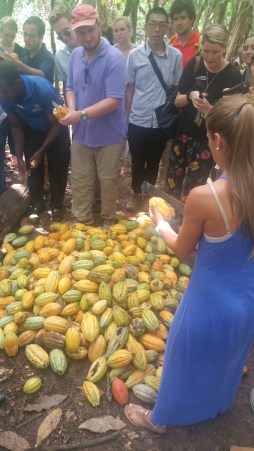
Others broke open the pods and dumped out the beans.
It was really, really (I mean, really) hot and humid. But this experience was just too cool! We learned how the beans are fermented on banana leaves; then dried on wire screens,
After the cocoa beans are fermented and dried, they are bagged and sent to a warehouse. 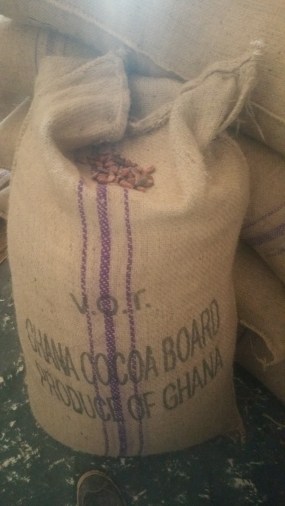
Then Tony’s takes responsibility for getting the bags to the port, loaded on a ship and on their way to a processing facility in Belgium.
Perhaps more importantly, we learned that the Fairtrade certification is for real. And it works. The work conditions at ABOCFA are fair and safe and collaborative. Everyone at the cooperative works hard, works together, works for the community. And the guaranteed price from Fairtrade ensures that ABOCFA can plan and invest.
Equally important, we learned that Tony’s pays a premium on top of Fairtrade. This premium provides ABOCFA the ability to make significant annual investments into its community. For example, because of the premium, the community’s school now has working toilets. Yeah, for real. From no bathrooms to bathrooms. I can’t quite find the right word to describe it. But, let’s just say that, for ABOCFA, being Fairtrade and being in partnership with Tony’s, is just too cool!
Our last day in Ghana was as hot as the first. Just too hot.
On the morning of the last day our family – Lincoln, Tate, Christy and me – and a group of twenty five students boarded a bus for a day long visit to an outfit called Alive and Kicking.  This was a program organized by Semester at Sea. And, you got it by now, it was just too cool.
So, the back story. Two facts about Ghana:
(1) Football (soccer) is by far the most popular sport.
(2) Malaria remains a significant challenge throughout the country; in fact, nearly half of the deaths of kids under the age of 5 is from malaria.
Alive and Kicking was started in Kenya as a social enterprise that hand-stitches soccer balls; some are sold to make money; that revenue supports the give-away of balls emblazoned with health-related messages. The power of sport and the love of football are used to address seemingly intractable health related issues. The Alive and Kicking in Kenya started in 2004; it is thriving, earning sufficient revenue to sustain its operations and continue to fulfill its social mission. It actually has a sponsorship connection with FIFA (which suggests a counterpoint to one of my previous posts). One started up in South Africa but failed (which seems to reinforce what I shared in another post). There’s one in Zambia, started in 2008. And the one in Ghana started in 2012.
We were welcomed to Alive and Kicking-Ghana by Wilson. He’s the General Manager; he’s smart, articulate and charismatic. We walked through what seemed to be where soccer ball stitching might take place and to a back room. There, Wilson presented on the history of Alive and Kicking and how it operates in Ghana. He made it clear that it is by the end of this year – 2017 – that Alive and Kicking- Ghana is expected to be financially self-sufficient.
Then, we all moved to the ‘production floor’.

Each person sat at a stitching station with individual pentagon-shaped panels in front of them.
We got a lesson on how to stitch a soccer ball. And, then everyone started stitching. It’s really hard work. It requires high dexterity, good eye sight and strong fingers. And, it is open air and no AC. And, yep, it was just too hot.
The staff helped everyone. They threaded needles. They applied beeswax to the thread to ensure it slides through the leather panels. They showed us how to minimize the likelihood of poking ourselves or stabbing a bystander. And we all worked. And we all proved to be slow at the work.
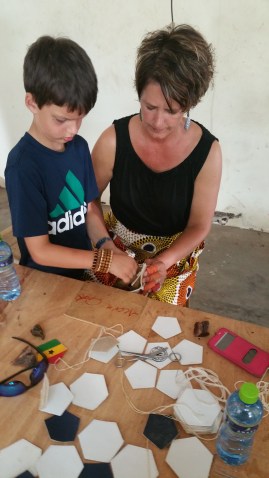
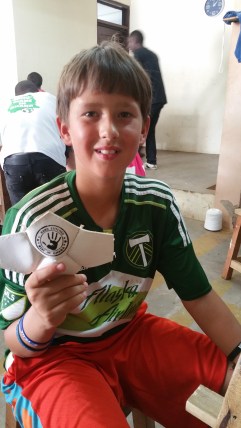
By lunch time none of us had yet completed our stitching so we needed to take a break, go eat and return to continue stitching. After lunch, we all stitched for another hour and half; and no one was yet done. The Alive and Kicking staff agreed to finish our stitching work and we got to see them in action.
They worked hard and fast and effectively; even it seems just way too hot to work so hard. When it comes to a creative, engaged and sustainable model for addressing difficult problems – like malaria – Alive and Kicking-Ghana is, without question, way too cool.
Ghana is a country I want to return to at some point in the future. Like those who work at ABOCFA and Alive and Kicking, the Ghanaians are inspiring. They work hard; they commit to the benefit others; they smile often.
 Marshall Family's Grand Adventure
Thanks Scott.
LikeLike
did you get to keep your ball? The humidity and I would not survive, what a wonderful eperience. No more hershey bars for me!! AB
LikeLike
So cool to s the impact sustainable enterprises have on real people.
LikeLike
Oops – that was supposed to say “so cool to SEE…”
LikeLike
You are so cool! Thank you for the entertaining and informative posts.
No more Hershey bars for me either.
LikeLike