

I am not an expert on much, if anything, but I’m always trying to learn more. Book learning can only take us so far. At some point in time, over the course of one’s education in the US, the caste in India and apartheid in South Africa are ‘covered’. I have to admit that I don’t recall when I studied them in school; or what I learned about them. Did it actually get covered? If it did, I most certainly didn’t gain much insight into either.
Maybe I wasn’t paying sufficient attention when these topics were discussed. Or maybe sufficient attention is not given to these topics.
Today I remain very far from an expert. But visiting India and South Africa – one after the other – piqued my curiosity. I should know a bit more. So, what follows is some of what I’ve learned, observed, considered and believe.
In India, we took a two night, three day tour up into the mountains outside of Cochin. At one point in our adventure, our tour guide who accompanied us said he’s of the Brahmin class. And, when he said it, it was clear that it mattered. A lot. His parents will arrange his marriage and his future bride will be from the same caste. He carried himself with a certain self-confidence; not arrogance, but certainly with an air of high class. When we found ourselves in a ‘middle class colony’, he whispered that the inhabitants are of the ‘untouchable’ caste. He added that he has to be careful to not speak out loud about it.
There are, essentially, five castes: the Brahmins (priestly people), the Kshatriyas (rulers, administrators, warriors), the Vaishyas (artisans, merchants, tradesmen and farmers), and Shudras (laborers). And, there are those people deemed to be entirely outside societal boundaries, known as the ‘untouchables’. The British Raj, through administrative rules, concretized the caste system. Generally, professional and social opportunities and engagements were determined by caste. In 1950 the Indian constitution established a ‘reservation’ system that recognized the caste system and its inherent inequity and reserved public sector position and university admissions to otherwise excluded classes. It’s kind of like affirmative action in the US.
But make no mistake – caste is still real today; it’s embedded in the psyche of the people and in their social structure.
Apartheid was formalized through the Population Registration Act of 1950. It designated four racial groups based on appearance, known ancestry, socioeconomic status: the four groups included “black”, “white”, “colored”, and “Indian”. Places of residence, employment, property rights and even citizenship became defined by this classification. The picture of a plaque with my shadow in the middle of it describes the “almost too crazy to believe” process that was undertaken to classify humans. It’s worth a read.
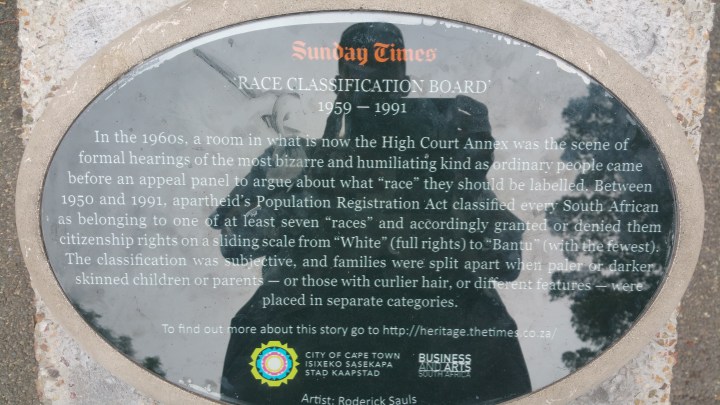
I’m not much of an artistic photographer but there was some intent behind this photo – my shadow (the black form of a white man) reflected in words describing a process of dehumanization based on skin color. Did you know that anyone who takes this same photo will look the same?
About a decade after the Registration Act, forced segregation was started in earnest. From 1960 to 1983 about 3.5 million non-white South Africans were removed from their homes and forced into segregated neighborhoods. The neighborhoods are referred to townships; townships are most often a massive clutter of tin and wood huts spread across broad, flat land. In 1997 apartheid was abolished as a regulatory framework.
But make no mistake – apartheid is still real today; it’s embedded in the psyche of the people and in their social structure.
But will there be change in India and South Africa? Will these de-humanizing schemes face a slow but certain decline and death?
For our Brahmin tour guide, it didn’t seem like much had changed. He’s awaiting word from his parents on who he’ll marry and when. And, his future wife will most certainly be of Brahmin class. And their social circles will be of ‘class’.
However, for the 18 year old woman, who was born and raised as an ‘untouchable’, whom we met in the ‘middle class colony’, who spoke flawless English, much has changed. She the older one, in the yellow sari and brown pants, on the left side of the photo.

She’s been able to avoid early marriage. She’s on a pathway to college. She was one of the most extraordinary people I’ve met on this journey around the world. Unbeknownst to her, she’s a heroine. Brave, smart, generous, driven. Imagine if there are more 18 year olds like her in India. If it’s true, then – with apologies to our tour guide – the caste system is on the road, albeit long, to oblivion.
For India, caste and poverty are not the same; but they are highly inter-correlated. And India is home to poverty in its most extreme form. But India’s economic growth over the past decade has been quite exceptional. An average of more than 7% over the past 10 years! If the economic growth persists and is led by this woman and her like-minded peers, then the persistence of the caste-poverty dyad will be less and less likely.
So, what about South Africa? Here’s a picture I took of a township as we drove by on the freeway.

It’s blurry. I believe it serves as a metaphor for how the minority white upper and middle class South Africans and the minority middle class black South Africans look at those who live in and are virtually locked within the townships. I am taking a risk by over-generalizing but so be it. It seems to me that the minority who enjoy clean water, healthy food, excellent wine and craft beer and good internet are thriving by, in part, racing past the townships and ensuring the townships remain blurry in their minds. Best to not focus in.
Although the photo is blurry you might be able to discern kids with a football in a sandy field with tin and wood shacks behind them. The photo is blurry but the image is clear. The socio-economic barriers for these kids may as well be 30 foot high walls; impenetrable. If nothing changes, they’ll be playing in that same field with their kids, and their kids’ kids.
Not to get too academic but it’s worth introducing a metric of wealth concentration. The GINI coefficient is a common measure of the extent of wealth concentration in a country: numbers closer to zero indicate fairly equal income distribution; numbers closer to 100 indicate more unequal distribution. South Africa – at a GINI of .63 – is considered to be have the highest GINI in the world. Stated otherwise, it has the highest wealth concentration around. Stated otherwise, there’s a huge swath of the South African population that has little to no wealth and is not productively engaged in the economy.
There are black South Africans who have obtained some measure of wealth; and there are some white South Africans who have dropped into abject poverty. But who’s kidding who? That GINI coefficient is a symptom of a post-apartheid world – 20 years on – that looks, feels and acts a lot like it did before the ‘post-‘ was added.
So, where to now? Well, for us it’s to Ghana. A country with deep history of trouble and tragedy, a most recent twenty years of stability and growth, and a quite promising future. As a tourist, one might choose to go up the coast to visit ‘castles’ built by the Dutch and Portuguese, then used by the British to ‘store’ slaves who were unwillingly captured, bound and sent by ship to the New World. It makes me think about another country’s history; one that I am more familiar with. And, how it has attempted to resolve its de-humanizing policies and practices of the past, and what work – significant and substantive – yet remains. I am not an expert on much, if anything, but I’m always trying to learn more.
 Marshall Family's Grand Adventure
Thank you
LikeLiked by 1 person
very informative Scott, unless you grow up in those country’s or make it life’s work to study them how would a person know all the dynamics, such good life lesson’s for you and your family. AB
LikeLike
Scott I am always trying to learn more. You made me pause and look at the world through a different lens this morning. No amount of brick and mortar education can imitate true life experience. You are an artistic photographer and have humanized the shadow that we all share. Thank you for sharing your observations, thoughts and shadow. Sincerely, J
LikeLiked by 1 person
Proud to have you as a friend.
LikeLiked by 1 person
I am curious as to what the GINI is for the United States. So much wealth concentrated in the control of a few. The US has a fairly large middle class that is decreasingly economically productive. Is it really possible that the young Untouchable young women will come to PDX? I will donate funds to help make it possible.
LikeLike